Campaigns
Campaign 01
Could Be You
Turning real creator earnings into a creator acquisition engine.
2,267 sign-ups and 202 merchants activated in the first 28 days, at an 8.9% activation rate.



Read the full case study ↓ Show less ↑
The challenge
Creator platforms often make broad promises about what creators can achieve. The challenge was to make the opportunity feel real, specific and attainable.
Instead of relying on generic messaging, the campaign was built around Selar's real creator earnings data from 2025. The proposition was simple:
People like you are already earning from this. You could be one of them.
Every campaign interaction was designed to move directly towards account creation rather than relying on a soft lead-generation journey. The conversion path was:
Ad → Landing page → Free Selar account
The campaign covered multiple markets and required understanding how different audiences responded to different creator stories. The campaign report describes this as a direct creator acquisition campaign built around real income, niches and locations.
What I worked on
I approached the campaign as both a marketing and growth problem. The work involved:
Creative strategy
Rather than creating generic ads about Selar, we built creatives around specific creator stories, categories and income narratives. Examples included:
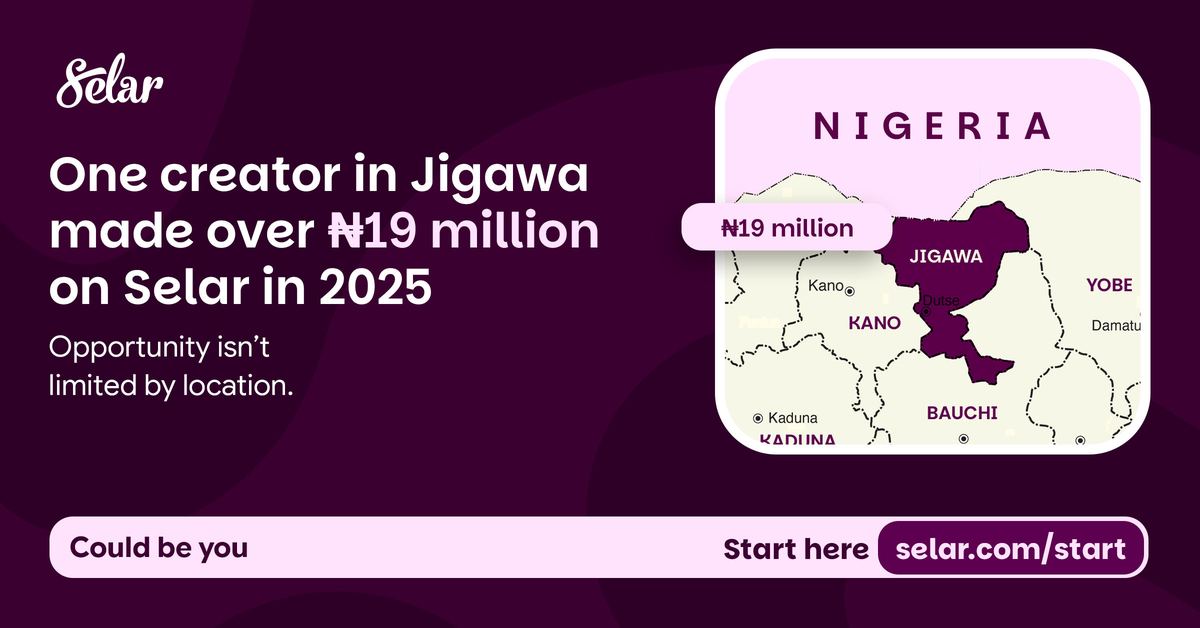
- A creator from Jigawa earning ₦19 million
- Spiritual content generating recurring income
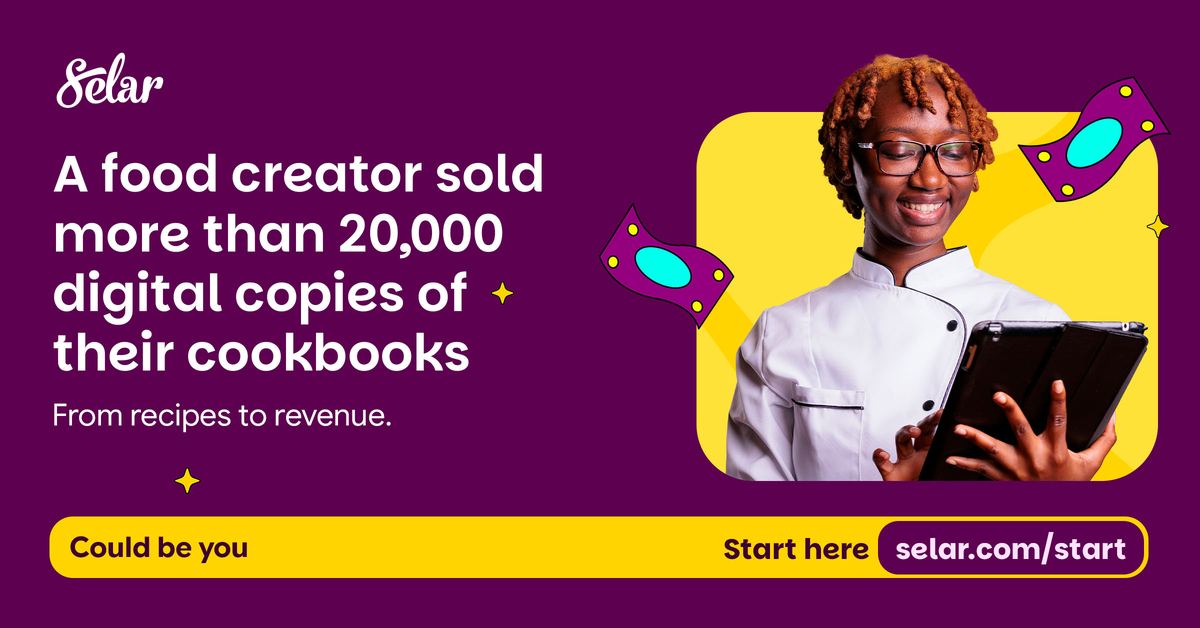
- Cookbooks turning an existing skill into a product
- Ebooks and templates as part of the digital product economy
Market segmentation
Different audiences behaved differently, so campaign performance was analysed across:
- Nigeria
- African countries
- Francophone Africa
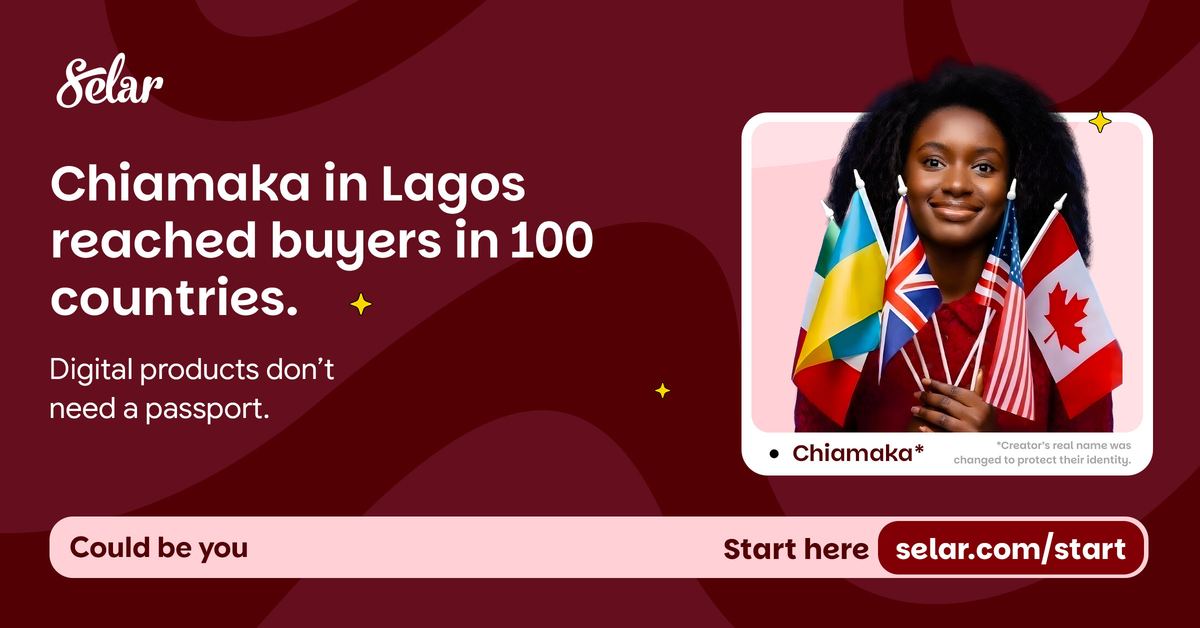
- Diaspora markets
Performance analysis
The campaign was reviewed weekly to understand:
- Sign-ups
- Merchant activation
- Cost per sign-up
- Creative performance
- Segment performance
- Spend efficiency
Creative optimisation
When the data showed that some creatives were consuming budget without producing sustained results, they were stopped and budget was consolidated around stronger performers. Five creatives were turned off after three consecutive weeks of data.
Results
At the end of the first 28 days:
The campaign had already surpassed its full 60-day mid-range projection of 1,369 sign-ups, achieving 2,267 at the halfway point — 65% above target.
One of the most interesting findings was that volume and quality were not necessarily coming from the same creative. The Jigawa creative generated 1,546 sign-ups and became the campaign's dominant acquisition asset, while the Ebooks & Templates creative generated fewer sign-ups but had the highest activation rate at 15.9%.
What I learnt
The campaign reinforced an important growth principle for me:
The creative that generates the most users isn't always the creative that generates the best users.
Optimising solely for cheap acquisition can create a volume problem downstream. Looking at merchant activation alongside sign-ups changes the question from "which ad gets people to register?" to "which message attracts people who are actually ready to use the product?"
Campaign 02
DialX Impact 2026
Building an audience, not just promoting an event.
459K+ views and 7.5K+ link clicks generated for a brand-new event with no prior audience.
Read the full case study ↓ Show less ↑
The challenge
DialX was not an established conference brand with an existing large audience. The task was therefore bigger than simply selling tickets. We needed to:
- Introduce the brand
- Establish its proposition
- Build an audience
- Generate awareness
- Drive traffic and registrations
- Create credibility around the event
- Create enough content and evidence to support future growth
The central idea became Ideas That Work, positioning DialX around conversations about execution, growth, impact, career, leadership and building meaningful things. The campaign objectives included awareness, event traffic, registrations, audience development, content generation and building digital proof for future speakers, partners and sponsors.
Strategy
A key decision was to avoid making every piece of content an advertisement for the conference. Instead, we built content around ideas people would care about even if they had never heard of DialX. The strongest themes were:
- Execution
- Growth
- Impact
- Career
- Leadership
- Action
- Community
- Personal excellence
The result was that DialX started functioning as an idea-led brand, rather than simply an event page.
Distribution
The campaign was distributed across:
- X
- X Spaces
- TikTok
- Website
- Paid social
Instagram became the main community and engagement platform, while Facebook became a particularly strong traffic and distribution channel.
Results
Across Instagram and Facebook:
The audience was also highly relevant to the intended market. 99.2% of the Instagram audience was in Nigeria, with the largest concentrations in Lagos, Asese, Benin, Port Harcourt, Ibadan and Abuja. The audience was predominantly 18 to 34.
Website contribution
Paid social accounted for 44.2% of website users, making it the largest identifiable acquisition source.
What I learnt
The biggest lesson was that attention is easier to generate than owned audience.
The campaign successfully created awareness and engagement, but the next growth challenge is converting that attention into assets DialX owns, such as email subscribers, WhatsApp members and a recurring community. That became part of the strategic direction for the next phase of DialX.
Campaign 03
Selar Growth
Building and optimising an acquisition engine around a creator-commerce product.
41,630 sign-ups and 12,366 creators/merchants across the H1 2025 growth programme.
Read the full case study ↓ Show less ↑
The challenge
Selar operates in a market where creator acquisition is not simply about generating traffic. A new user has to discover Selar, sign up, understand the product, create/list a product, and transact. That means growth has to be considered across the funnel rather than stopping at registration.
My work across Selar's growth function involved thinking about acquisition, activation, conversion, product adoption and measurement.
What I worked on
Paid acquisition
Managing and analysing performance across platforms including:
- Google Ads
- Meta Ads
- TikTok
- Other paid channels
Funnel optimisation
Looking beyond clicks and impressions to understand:
- Sign-ups
- Merchants
- Activation
- Pro Plan conversions
- Affiliate subscriptions
- Cost per acquisition
Attribution and tracking
A recurring part of the work was improving measurement through:
- UTM structures
- Campaign tracking
- Channel-level reporting
- Funnel analysis
- Performance dashboards
Product marketing
Growth was also connected to Selar's products and features, requiring messaging and go-to-market thinking around products such as Tickets, Page Builder, Show Love and multi-currency capabilities.
Performance
During H1 2025, the growth work covered:
These figures reflect the performance of the broader growth programme; the metrics I directly owned are distinguished from overall company results in the full case study.
The growth philosophy
My approach to growth has increasingly moved from:
"Which campaign should we run?" towards "What system will consistently move people from discovery to activation and revenue?"
That shift is central to how I now think about product marketing and growth.
Campaign 04
Google Ads at Selar
When paid search became a major acquisition engine.
41.6K+ sign-ups from 303K+ clicks, at roughly ₦395 average CPA.
Read the full case study ↓ Show less ↑
The challenge
Selar needed scalable creator acquisition. Google offered something particularly valuable because users were already searching for things connected to Selar's product categories and creator-commerce use cases. The challenge was to turn that existing intent into efficient user acquisition while understanding which users ultimately became valuable merchants.
What I worked on
The programme covered:
- Search campaigns
- Display
- YouTube
- Campaign segmentation
- Landing pages
- Keyword strategy
- UTM tracking
- CPA analysis
- Conversion analysis
- Merchant performance
- Campaign optimisation
The work also required distinguishing cheap sign-ups from valuable acquisition, because a user registration was not necessarily the end goal.
Performance
Across the H1 2025 Google Ads programme:
These are programme-level results; the full case study explains exactly which campaigns, decisions and optimisation work I personally owned.
A particularly useful story
One of the things worth showing here is the difference between user acquisition CPA and merchant acquisition CPA, because the latter is much closer to business value. That distinction demonstrates that I think beyond the top of the funnel.
What I learnt
Paid acquisition is only as good as the downstream funnel. A campaign can have an excellent CPA while still producing poor commercial outcomes.
That is why I increasingly look at paid media together with activation, conversion and product behaviour.
Campaign 05
LoadConnect
How I took a marketplace from 0 to 20 users in one week.
Read the full case study ↓ Show less ↑
The problem
LoadConnect had launched a platform but had zero users. The immediate challenge was to get truck owners onto the platform. The obvious problem was access: the target users were difficult to reach, initial outreach to truck parks wasn't working, and even the language barrier became an obstacle.
What I did
I started with direct, offline acquisition. I went to truck parks and attempted to reach truck owners. When the first approach ran into a language barrier, I returned with a Hausa translator. That still wasn't producing enough results, so I reconsidered the problem.
I realised the prospects I wanted were already using Jiji to solve a related problem. Instead of continuing to search for them offline, I went where they already were. I identified relevant contacts and began reaching out individually through WhatsApp.
Result
What this says about how I work
I don't think growth is about having a preferred channel. It is about finding the shortest route between the problem, the customer and the behaviour you need.
When the first strategy failed, the answer was not necessarily to execute it harder. It was to change the strategy.
Campaign 06
Keble Community Growth
0 → 500 members through distribution, referrals and experimentation.
Read the full case study ↓ Show less ↑
The problem
Keble had attempted to grow a Telegram community but growth had stalled and engagement was poor. The opportunity was to build a more active community around financial knowledge while eventually turning that audience into users of the product.
Strategy
I worked across several acquisition and engagement mechanisms:
- WhatsApp community
- Personal network distribution
- Social media
- Referral mechanics
- Prize-based campaigns
- Lead magnets
- Newsletters
- Community partnerships
- Sponsorships
We also used surveys and ongoing observation of community behaviour to understand what members actually wanted.
Results
The interesting part
The objective wasn't just community growth. The next question was:
Can this audience become users of the product?
We began deliberately connecting community activity to product awareness and activation, using reminders, calls and surveys to understand whether members were becoming Keble users.
What I learnt
Community can become a growth channel when it is treated as part of the product funnel rather than as an isolated social initiative. The real opportunity was:
Acquisition → Engagement → Trust → Product activation
Campaign 07
Techeconomy
Rebuilding a fragmented marketing operation and driving 20% MoM organic growth.
Read the full case study ↓ Show less ↑
The challenge
When I joined, website traffic had stagnated and digital brand recognition was limited. Marketing activity was fragmented and lacked a cohesive strategy.
What I did
I worked on:
- Marketing strategy
- Content
- Social media
- Newsletter marketing
- Meta Ads
- Brand positioning
- Rebranding
I also launched two separate newsletter campaigns and worked on a silent rebrand designed to improve how the company was perceived.
Result
The newsletters continued to exist and grow after my departure.
What I learnt
Growth often does not require one spectacular campaign. Sometimes the biggest opportunity is bringing disconnected activities into a coherent system where content, distribution, brand and acquisition reinforce one another.
Projects
Project 01
Engineering for Marketers
Building a bridge between marketing and technology.
Read the full case study ↓ Show less ↑
Engineering for Marketers was built around an idea I find increasingly important: modern marketers need to understand the systems underneath the channels they operate. The project explored the intersection of:
- Marketing
- Technology
- Analytics
- Automation
- Product
- Growth
Rather than treating technology as something marketers hand over to technical teams, the project aimed to make technical concepts more understandable and useful to marketers.
Why I built it
My interest in product marketing comes partly from being comfortable operating between functions. I want to understand:
How does the product work? How is the user behaving? How is the system measured? How can the marketing system influence that behaviour?
Engineering for Marketers became an expression of that intersection.
What it demonstrates
- Technical curiosity
- Content development
- Marketing education
- Product thinking
- Ability to simplify technical concepts
- Interest in the relationship between systems and growth
Project 02
Neighbourly
Building a local discovery product from the ground up.
~100 businesses listed at beta launch, in a market with no prior structured discovery layer.
Read the full case study ↓ Show less ↑
The problem
Redemption City has a large number of businesses, services and independent vendors, but discovering them can be difficult. People often rely on:
- Word of mouth
- Personal knowledge
- Random social posts
There was an opportunity to create a structured discovery layer for businesses inside the community.
The product
Neighbourly is a business directory built specifically around businesses and services in Redemption City. The product allows businesses to be listed and discovered across categories, with different listing tiers designed to create both accessibility and monetisation opportunities.
My work
Product strategy
Defining the problem, audience and product proposition.
Go-to-market
Developing the initial approach to getting businesses onto the platform.
Business acquisition
Creating the field-agent model and process for registering businesses.
Monetisation
Thinking through:
- Basic listings
- Featured listings
- Premium positioning
- Pricing
- Promotional offers
Distribution
Developing community-based channels and offline acquisition mechanisms to complement the website.
Early traction
The larger opportunity was the size of the addressable business ecosystem within Redemption City.
Why this project matters
Neighbourly represents a different side of my work. It isn't simply "here is a campaign I ran." It is:
Here is a problem I identified, a product I helped shape, and a distribution model I developed to get the product into the hands of its first users.
That makes it particularly useful in a Product Marketing & Growth portfolio.